Te Henua Enata: the Marquesas beyond the postcard
A mixed heritage listing offers a way to discuss inhabited environments together. It should not freeze Marquesan people in an archaeological past.
Pasifika AI / Kanaky Tech ·
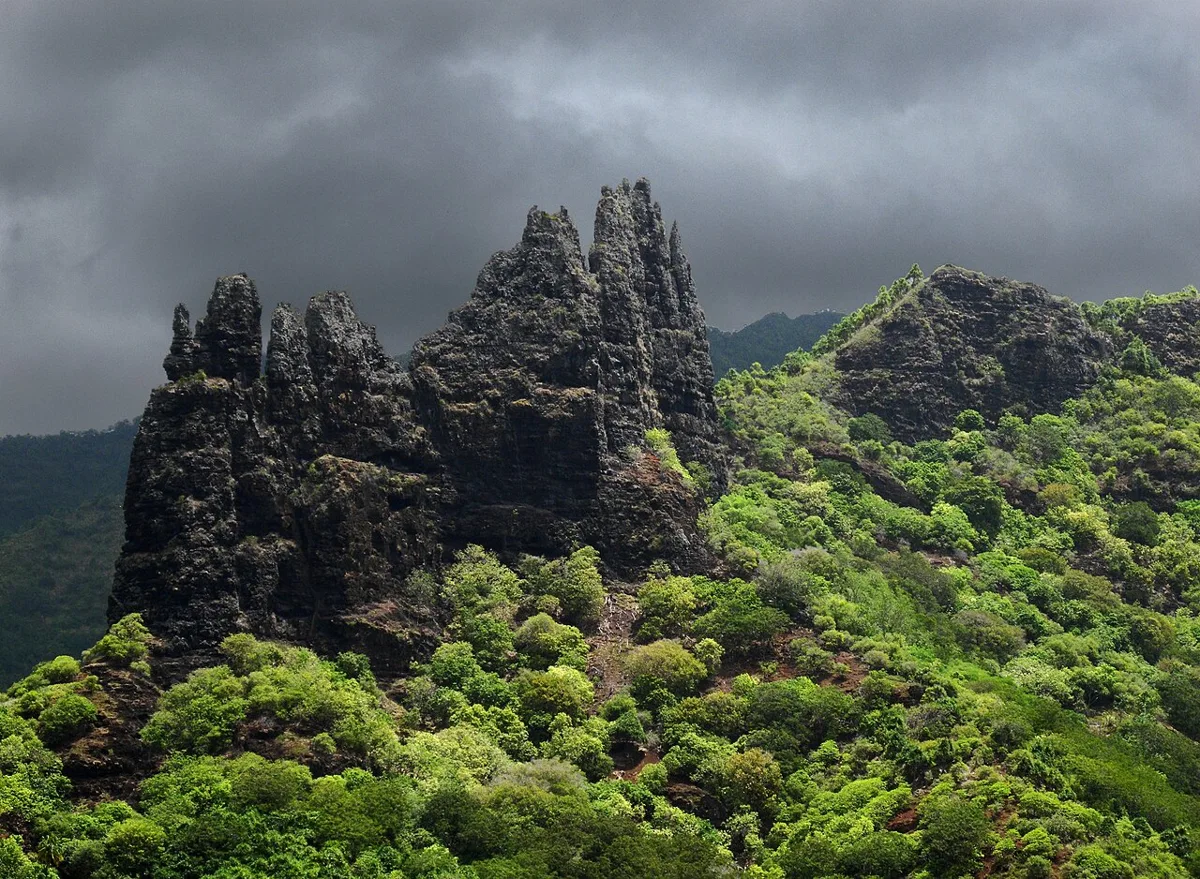
Landscape near Hatiheu Bay, Nuku Hiva. One named Marquesan setting, not a portrait of every island.
Steve Berardi · Image record · CC BY-SA 2.0 · Resized and converted to WebP.
The documented starting point
Te Henua Enata – The Marquesas Islands is a mixed World Heritage property, recognised for cultural and natural values. UNESCO connects archaeological evidence of settlement with the islands’ distinctive terrestrial and marine environments. The listing concerns a defined serial property, not an assertion that every place in the archipelago has identical status.
A closer reading
Research guidance · Pasifika AI
Read the property description with two questions: what evidence concerns human occupation, and what evidence concerns ecosystems? Keep the island or component name attached to each example. In a visual essay, pair a landscape description with a question about present-day stewardship. Do not infer the meaning of a carved figure from its shape alone. Use the listing as a starting bibliography, then seek the interpretation of Marquesan cultural institutions and the people connected to the particular place.
A landscape without invented symbolism
Research guidance · Pasifika AI
Suppose a photograph shows cliffs, vegetation and a bay. Those are safe starting observations. The photograph alone cannot tell you which stories belong to the valley or what a nearby carving represents. Attach the island name and photographer’s record, then use a separate cultural source for any interpretation. In a short illustrated essay, this division gives readers two ways to check your work: inspect the image and read the evidence for the claim.
What this guide does not establish
Research guidance · Pasifika AI
A broad archipelago label cannot identify a person’s language, island or affiliations. Avoid “lost civilisation” language: the heritage of earlier generations and living communities belong in the same conversation.