Taputapuātea: reading a land-and-sea heritage site
A photograph of a marae shows only part of the story. This guide helps you read the surrounding landscape without turning a sacred place into a decorative backdrop.
Pasifika AI / Kanaky Tech ·
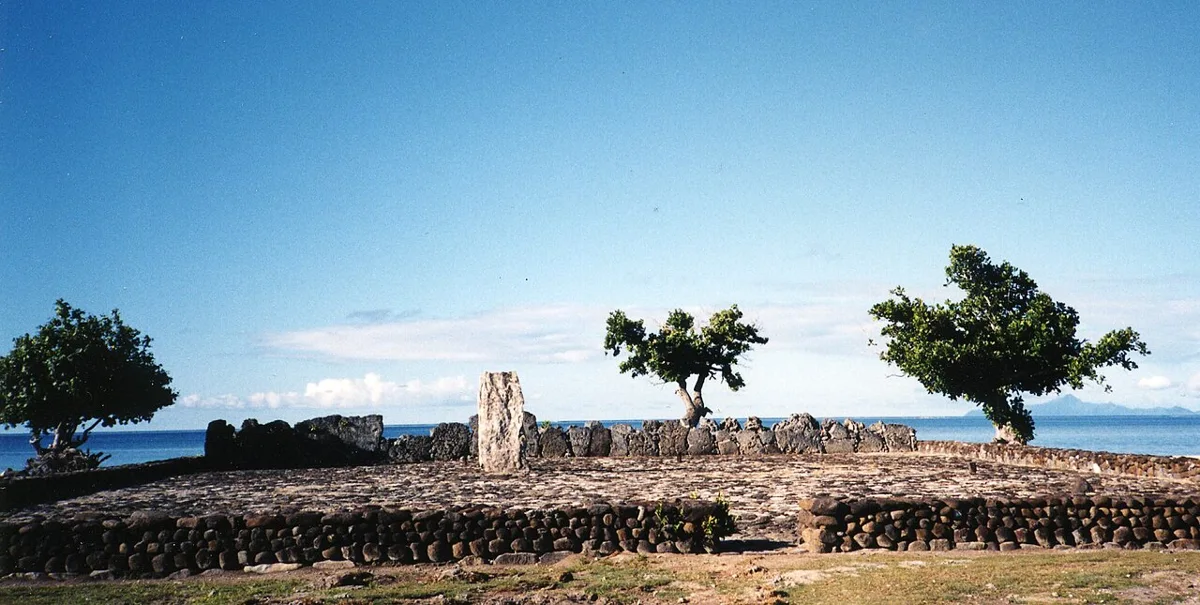
Taputapuātea marae on Raʻiātea, as identified by the photographer. The image shows part of a wider land-and-sea heritage site.
Michel-georges bernard · Image record · CC BY-SA 3.0 · Resized and converted to WebP.
The documented starting point
Taputapuātea is a cultural landscape on Raʻiātea in the Society Islands. UNESCO describes a marae complex within a wider setting of valleys, lagoon, reef and ocean. The site connects ceremonial, political and social histories; its meaning is not confined to its stone structures.
Source : UNESCO — Taputapuātea
A network maintained by voyaging
UNESCO describes gatherings linking chiefs, warriors and priests from different islands. Canoe building and ocean navigation supported those relationships. The marae complex therefore belongs in a history of connections as well as a history of buildings.
Source : UNESCO — Taputapuātea
A closer reading
Research guidance · Pasifika AI
Open the UNESCO description and draw three columns: built spaces, land features and maritime connections. Place each named element in its column, then ask which relationships disappear when a caption says only “ancient temple”. For a school presentation, keep Raʻiātea and Taputapuātea visible on every slide. Compare this place with a named marae in Aotearoa only after describing each in its own context. Similar words do not make their histories interchangeable.
A caption to improve
Research guidance · Pasifika AI
Consider the draft caption “A temple in the Pacific”. It leaves out the name of the place, the island and the relationship with the surrounding landscape. A more useful caption identifies Taputapuātea on Raʻiātea, describes the visible structures and sends the reader to the heritage account for interpretation. The correction adds verifiable context instead of an invented dramatic story. It also makes the image easier to find for a reader researching this particular site.
What this guide does not establish
Research guidance · Pasifika AI
This overview is not an invitation to enter restricted spaces or reconstruct ceremonies. Ask the site’s custodians about access, photography and interpretation. UNESCO recognition documents heritage significance; it does not transfer authority over a place to its visitors.